Yoga Block vs. Pilates Ball
A head-to-head across six yoga poses and four rehab staples — including the one everybody uses the ball for, which is the one I'd hand back, and the handful where the ball genuinely wins.
If I could keep exactly one prop for the rest of my teaching life, it would be the block, and it would not be a close call. Not because the ball has no uses — it has a few good ones, and I'll give it credit where it's earned — but because the block has a property the ball can't match at any price.
The block is a known quantity.
The problem with the ball is that it's never the same ball
Walk into a studio, reach into the bin, and you'll get some ball. Seven inches, or nine. Half-inflated by whoever used it last, or firm enough to bounce. There is no standard, and nobody's checking. Two students on adjacent mats are holding two different props while I give them the same cue, and neither of them knows it.
That matters enormously in the kind of work I do, which is both precise and built on the assumption that when I say press into the prop at about 50% available effort, the prop will answer the same way today as it did last Tuesday. A block answers the same way every time. It's rigid, its three dimensions are standard, and it does not care how the last person left it. It's that it's the same firm, every single time. I can build a progression on it.
I'll say the quiet part: I would happily bring a block to my next reformer session and use it for every cue that calls for a prop between the thighs. The ball is there because it's soft and it's traditional, not because it's better.
But — and I mean this — the ball has three jobs it does better than the block does. I'll show you those too. This is a review, not a grudge.
The Yoga Demo
1. Supported Bridge (Setu Bandha), prop under the sacrum
Block: Lift the pelvis, slide the block under the sacrum — the flat bony plate, not the low back — at its lowest height. Lower down and let the full weight of the pelvis transfer. Within a minute or so, the low back stops bracing. That's the pose working.
Ball: The pelvis lands on a surface that deforms and rolls. The low back never fully lets go, because it's answering a question the ball won't stop asking.
Verdict: Block, decisively. Restorative work requires an object that doesn't move. If the prop keeps recruiting the muscles you came to unload, you're not resting — you're doing a very slow, very boring stability drill.
2. Bridge with the prop between the thighs
Block: A fixed spacer at a known width. The femurs can't drift, the knees can't splay, and adductor tone shows up as a byproduct of holding a position — not as a white-knuckle clamp.
Ball: The classic. Squeeze the ball, feel the inner thighs. It does work — but you can't reproduce it. Half the class is squeezing a soft ball at 60% and the other half is squeezing a firm one at 30%, and I have no way to standardize the dose.
Verdict: Block. And if you want graded effort, you don't need a compliant prop to get it — you can press into a block at 20%, 50%, or 80% just fine. Effort is generated by you, not by the object.
3. Reclined Twist, prop between the knees
Block: Keeps the knees stacked and the pelvis honest as the legs lower. The block holds the relationship, so the twist happens where you intended it instead of collapsing into the lumbar spine.
Ball: Compresses under the weight of the top leg. The stack quietly degrades. Nobody notices, and the twist migrates south.
Verdict: Block.
4. Triangle / Half Moon, prop under the hand
Block: Brings the floor up so the pelvis can stack correctly instead of the spine side-bending to make up the distance. This is the pose that makes the case: a block isn't a concession, it's what makes the shape structurally legible.
Ball: Not a serious option. It rolls.
Verdict: Block. No contest.
5. Seated Boat (Navasana), ball at the low back, lifting one leg at a time
Ball: Tuck the ball into the low back and let it fill the space behind the lumbar curve. Now lift one leg, then the other, controlled. The ball gives the spine something to lean into and gently reminds you where the back of your ribcage lives — a low-stakes contact point that keeps you from dumping into a rounded, collapsed boat. As you press, it answers, and the feedback is exactly what you want here.
Block: A cork edge in the low back during boat is nagging poke, not support. The block can't fill a curve, so it just digs.
Verdict: Ball.When the job is to cushion and cue a curved region, compliance wins. This is the ball's kind of pose.
6. Extended Side Angle, ball gripped in the top hand
Ball: Grip the ball in the reaching hand and it becomes a small, deliberate load — a way to turn up the heat and the proprioceptive demand without dragging out a dumbbell. Squeezing it also gives the arm and shoulder girdle something to organize around and keeps the action of reaching the top arm a deliberate action instead of a noodle. A nice, portable way to make a strong pose stronger.
Block: A block in the hand here is just an awkward object to hold overhead. Grip is challenging and not doable for all sized hands.
Verdict: Ball. For added load and grip feedback in a standing shape, the ball is the better tool.
The PT Demo
7. The classic isometric ball squeeze
Ball: The prescription everybody gets. Squeeze, hold, breathe.
Block: Same position, same intent — but now the width is fixed and we can “prescribe” a more tangible amount of effort. Press into the block at roughly 50% of your effort for five rounds of breath. "Half" now means something similar for everyone in the room, and something identical for you next week.
Verdict: Block. This is the swap that bothers me most, because it's supposedly the ball's home turf. It isn't. The ball gives you feel; the block gives you a repeatable prescription. In rehab, repeatable beats feel.
8. Wall slide / mini squat, prop between the knees
Block: Holds femoral alignment through the whole descent. If the knees start to fall in, the block tells you immediately, because it's a hard edge and the geometry stops working.
Ball: Deforms as you descend, any alignment errors hide inside the morphing shape of the ball.
Verdict: Block.
9. Supine leg lowers, prop under the sacrum
This is the one round where I can genuinely argue both sides, so I will.
Block: It’s an honest fixed reference point for the pelvis and low back. As the legs lower and the load grows, one edge of the sacrum lifts away and you feel the exact moment you leave neutral. But that same rigidity is a liability here. Hard cork or wood under the sacrum can bother a sensitive low back, L5/S1 especially, and the block flattens the region it's under rather than letting the lumbar spine keep its natural curve. It also caps your range: because it's a hard, fixed height, the legs have to stay higher off the floor, so you can't progress into a “deeper” version of the lower even when the body is ready for it. (If you do use a block here, use a foam one rather than cork or wood, and drape a thin blanket over it — that alone solves most of the complaints.)
Ball: It compresses to meet the natural curve instead of fighting it, it's kind to an irritable low back, and because it yields, it lets the legs travel lower and the exercise actually progress. You give up a little of the block's crisp "you left neutral" signal — but for many spines, that's a fair trade. It also adds an extra layer of challenge due to its squishiness
Verdict: Ball edges it — BUT it depends on the spine. For a happy back that wants clean feedback, the block is worth a try. For a sensitive low back, or anyone chasing more range, the ball's give is the better property. Call this one a coin flip that lands on the ball a bit more often than not.
10. Thoracic extension / wall roll-down over the prop
Block: Hard cork against ribs and vertebrae. Some people tolerate it fine; plenty don't, and the ones who don't spend the whole exercise guarding against the prop.
Ball: The ball earns its keep again. It contours to the curve of the spine, distributes pressure across a broader area, and can be under-inflated on purpose for a gentler dose. When you're pressing a bony, curved region into a surface, compliance is genuinely the right property.
Verdict: Ball.
Where that leaves us
Score it however you like, but my count is roughly six to four, with one no-contest and one honest coin flip.
Notice the pattern in the ball's wins: boat, side angle, thoracic extension, and the leg lowers when the spine calls for it.
Every one of them is a job where you want the prop to give: to cushion a curve, to load a grip, to conform to a bony or irritable spine, to let a range progress.
That's the ball's real lane, and inside it, it's the right tool. A good thing to keep in mind if you’re ever questioning in real time which prop to reach for.
Try This Now (safe for every spine in the room)
We're starting with the single most forgiving setup there is — nothing loads the spine, and neutral is the whole point. This is appropriate whether your back is happy, cranky, or somewhere in between.
The move: supported adductor find, supine.
Lie on your back, knees bent, feet flat on the floor about hip-width apart. Let your spine settle into its natural neutral curve — you're not flattening the low back into the mat, and you're not arching it up. Just let it be.
Place a block between your inner thighs at its narrowest width (the low, flat orientation). It should sit there without you gripping.
Now press into the block at about 20% of your effort. Barely anything. Breathe all the way through it — if you're holding your breath, you're pressing too hard.
Hold for a full inhale and exhale, release, repeat five times. Keep the pelvis quiet and neutral the entire time. If the low back wants to flatten or the tailbone wants to tuck, back off the effort until it stays still.
That's it. No spinal flexion, no load, no balance demand — just a clean, dialed, reproducible dose of adductor tone with the pelvis held in neutral. Do it today, then do it tomorrow at the same 20%, and notice that you can actually find the same 20% again. That's the whole argument for the block, in one minute on your living room floor.
Now Tell Me
Here's what I actually want to know:how do you use your block, and how do you use your ball?
Is there a pose where the ball is non-negotiable for you?
A place you've quietly swapped a block in and never looked back?
A cue that only clicked once you had the right prop under you?
Hit reply and tell me — I read every one, and the best answers tend to become future posts.
I'll bet at least a few of you use a prop in a way I haven't thought of.
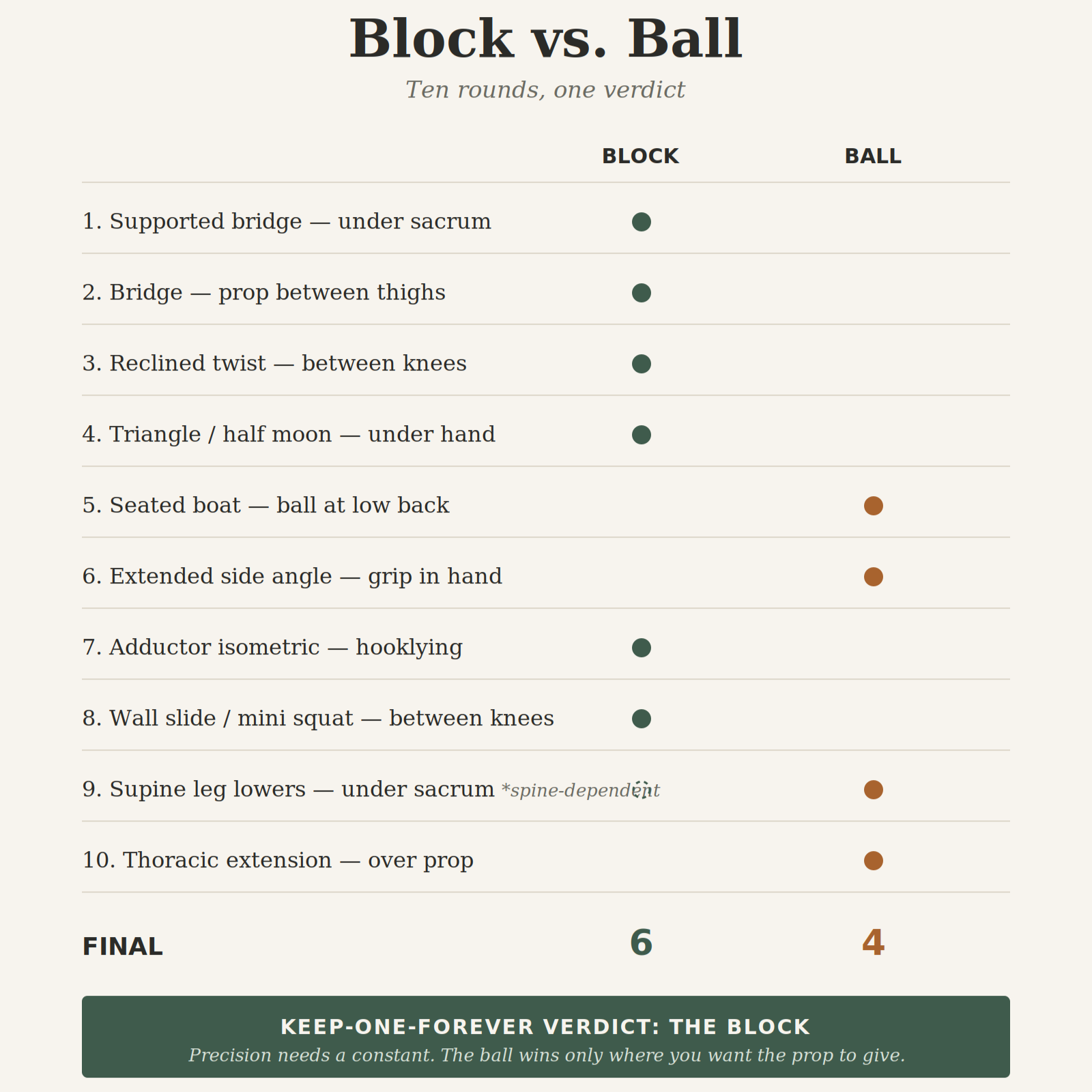
Ten movements, two props, one keep-forever verdict. The block wins the work that needs a constant; the ball wins where you want the prop to give.