Yin Yoga, Fascia — And Why This Matters If You Have a Spinal History
Walk into most yin classes and you'll hear some version of the same pitch: hold this shape for three to five minutes and you'll "release fascial adhesions," "unwind years of stored tension," or "get into the connective tissue that other yoga can't touch." It sounds plausible. It's also not what the science shows — and for anyone with a disc, facet, or post-surgical spine, that gap between claim and evidence isn't just an academic quibble. It's the reason yin can be the wrong tool for exactly the body it's often recommended to.
Let's separate what's real from what's marketing, and then talk about what that means if flexion, extension, or rotation are already complicated for you.
What Fascia Actually Is
Fascia isn't inert packing material. Think of it as a body-wide wrapping — a continuous web of tissue that surrounds and connects your muscles, organs, and joints, a little like the white webbing you see just under the skin on a raw chicken breast. It's not just there to hold things in place. Here's what's actually established about it:
It has mechanoreceptors. Translation: fascia can "feel." It's threaded with tiny sensors that pick up on pressure and stretch and report back to your nervous system. So when you sink into a long hold, part of what's happening is literally your body sending signals to your brain about how much tension it's under — not the tissue itself doing something dramatic.
It has some contractile capacity. Translation: fascia can tighten on its own, slowly. There are cells inside it (called myofibroblasts) that can shrink the tissue slightly — but over minutes to hours, not in real time during your yoga class. This finding is real and comes from legitimate research, but it's frequently stretched (sorry) well beyond what it actually shows.
Its ground substance is viscoelastic. Translation: fascia can act more like taffy or more like water, depending on conditions. Sustained pressure or heat can temporarily loosen it up, similar to how taffy softens when you work it. But like taffy left alone, it firms back up again — this is a temporary state, not a lasting change.
Put together: fascia is a real, responsive, living tissue. But nothing above says that holding a stretch for five minutes permanently reshapes it.
The Claim, Stated Precisely
Here's the causal chain yin marketing actually asks you to accept:
hold a passive stretch for three to five minutes → that sustained tension realigns collagen fibers → this produces lasting remodeling of the tissue → you experience this as "release."
Stated that plainly, it's easier to see where it falls apart.
What's Actually Happening in a Yin Hold
Two well-documented mechanisms explain nearly everything people feel in a long passive stretch, and neither requires fascial remodeling:
Viscoelastic creep. Translation: your tissue temporarily "gives" the longer you hold it — like a rubber band left stretched overnight looks a little longer the next morning, but slowly springs back to its original length once you let go. That's what's happening in your muscle and connective tissue during a long hold. The extra length you feel by minute five is real, but it fades over the following hours, not something that stays with you permanently.
Altered stretch tolerance. Translation: your nervous system, not your tissue, moves the goalposts. Your brain has a built-in alarm system that stops you from stretching too far, too fast. With time and repetition, that alarm gets a little more relaxed about how far you can go before it sounds — so you sink deeper, not because your tissue changed, but because your brain is willing to let you go further. This is the same reason regular static stretching (no yin required) makes you more flexible over time.
Put together: both of these are real and well-documented. Neither one is your fascia "releasing." What you're feeling in that pose is genuine — it's the story being told about why you're feeling it that doesn't hold up.
Why the Evidence Doesn't Hold Up
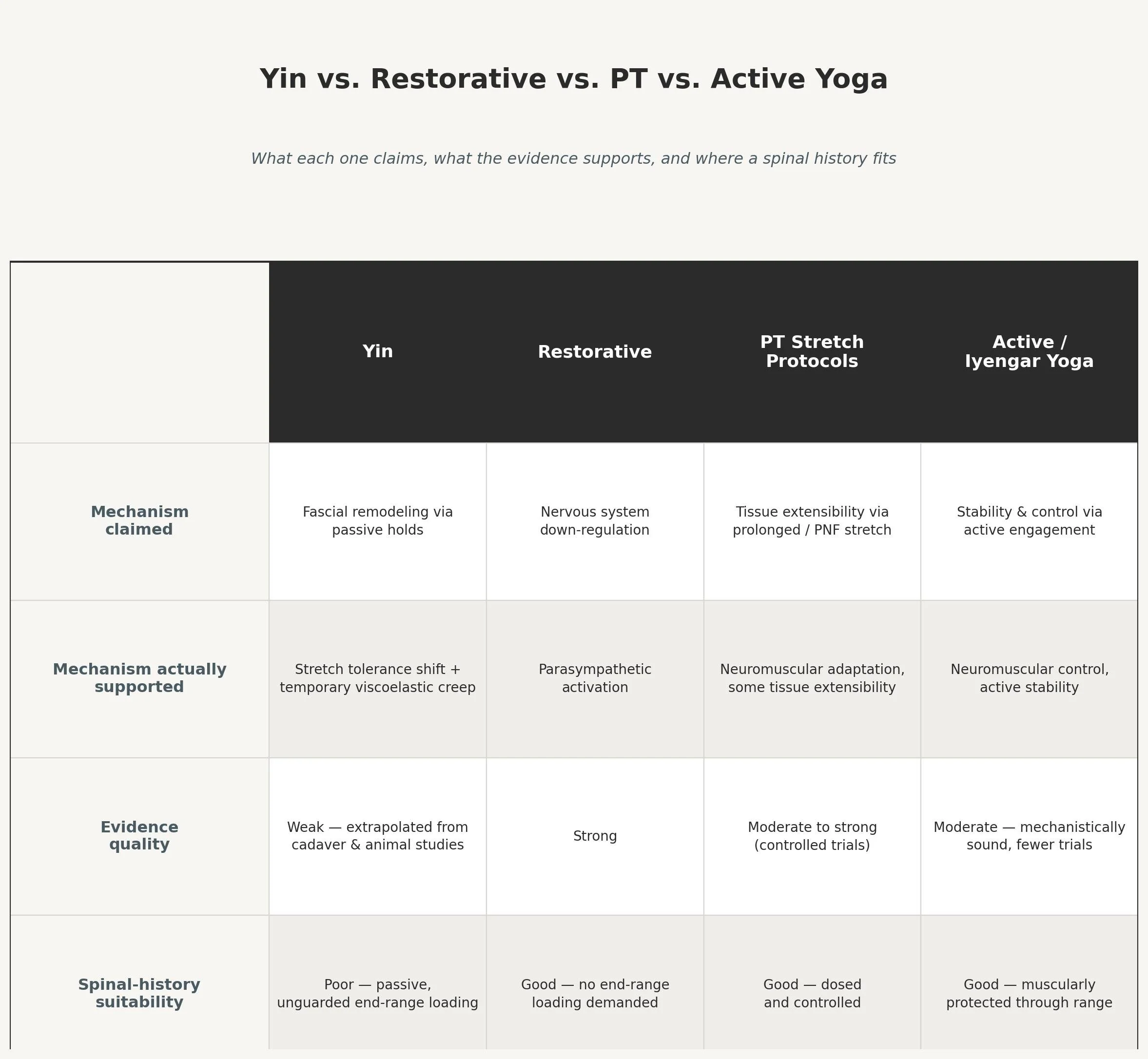
The research most often cited to support yin's fascia claims comes from cadaver and animal tissue studies, not living human practitioners. There are no controlled trials isolating a “yin-specific fascial effect” from the effect of any other sustained passive stretch. And the timeline doesn't match: genuine collagen remodeling — the kind seen in a tendon adaptating to training, or bone adaptating to load — takes weeks to months of repeated loading. Yin's language implies something closer to instant, session-by-session change.
That mismatch is the whole problem.
The Pivot: What You're Actually Left With
Strip away the fascia claim and here's what remains: a passive stretch, held at end range, for three to five minutes, with minimal muscular engagement protecting the joint.
That's not a neutral null result. It's a specific loading pattern — and whether it's a good idea depends entirely on what's underneath it. For a healthy spine, it's a reasonable way to spend a few minutes. For a compromised one, it's asking a vulnerable structure to sit unguarded at exactly the range where it needs support most.
Why That's a Problem If You Have a Spinal History
This is where the fascia conversation stops being theoretical.
Flexion-intolerant spines (the most common post-disc-herniation presentation): forward folds and rounded, seated-twist shapes held passively for minutes load the exact tissue you're trying to protect.
Extension-intolerant spines (facet arthropathy, spondylolisthesis, stenosis): passive backbends held at end range put sustained load on structures that need less compression, not more time in it.
Rotation-intolerant spines (post-fusion, certain disc and facet cases): deep twists held for minutes remove the muscular control that's supposed to be protecting that segment.
And modifying the shape doesn't solve the underlying issue. The problem isn't the pose — it's the model. Passive, unguarded, sustained end-range holding is the mechanism. You can round a fold or ease a twist, and you're still asking a compromised segment of your spine to sit unsupported at end range — for minutes at a time. That's different from a strength contraindication, where you can just swap the exercise. Here, the entire premise of the practice is the mismatch.
Active, alignment-based yoga works the opposite way: ongoing muscular engagement stabilizes the joint through range instead of removing that support to chase a "release." For a healthy spine, that's a style preference. For a compromised one, it's the difference between training control and abandoning it entirely.
What's Better Supported — PT and Active, Alignment-Based Yoga
Physical therapy makes narrower claims and backs them with better evidence. Prolonged mechanical stretch protocols and PNF techniques come with controlled trials, measurable range-of-motion outcomes, and specific dosing — not "this releases your fascia," but "this improves measurable range through this mechanism, and here's the data."
Iyengar-style active yoga sits in a similar place. It builds tissue tolerance and joint stability through active, controlled loading rather than passive collapse into end range — the direct opposite of yin's model, and a meaningfully safer approach for anyone with a structural history.
Restorative Yoga — A Different Goal Entirely
If you've made it this far into this piece, you're probably either a regular yin practitioner or genuinely curious about its relaxing side. So let's take a brief detour and shine a light on restorative yoga — because these two get lumped together constantly, and they shouldn't be.
Yin and restorative are often talked about like cousins. They're not even in the same family. Yin is a stretch-based practice trying (unconvincingly) to make a tissue claim. Restorative isn't stretching you at all — it's propping you up with bolsters, blankets, and blocks so your body doesn't have to do anything, with the specific goal of calming your nervous system. Comparing them is a bit like comparing a deep-tissue massage to a nap — both might leave you feeling better, but not because they did the same thing to your body.
Restorative's actual claim holds up well: fully supported stillness measurably lowers cortisol, improves heart rate variability, and shifts you toward parasympathetic, rest-and-digest function. That's a narrower claim than yin's, and it's backed by a stronger evidence base — closer to the well-replicated relaxation-response literature than anything fascia-specific.
It also offers many more options for a spine-safe practice, for a simple reason: it isn't asking any tissue to sit unguarded at end range. It's asking your nervous system to settle, not your fascia to "release." Different goal, different mechanism, and — not coincidentally — a claim the evidence actually supports.
(Restorative happens to be my hands-down favorite modality, for reasons well beyond what fits here. If you'd like a full blog dedicated to why, email me and I'll write it.)
Is There Any Case for Sustained Yin Practice?
Yes — just a smaller, slower one than it's usually sold on, and it comes with a real caveat.
If you have a healthy spine, sustained yin practice can be lovely. Consistent long-hold practice over months can plausibly support real range-of-motion gains and nervous system down-regulation, through stretch tolerance and gradual adaptation — not through session-by-session fascial release. That's a legitimate, modest benefit, and there's nothing wrong with enjoying it for what it actually is.
But if you have any restrictions when it comes to your spine — anything that makes flexion, extension, or rotation complicated — this is the point to go back and reread the section above, "Why That's a Problem If You Have a Spinal History." For that population, the honest answer isn't "yin, but modified." It's best to skip it.
The Honest Takeaway
Sustained holds can genuinely help the nervous system release protective guarding — that's real, and it's valuable. But that's a different claim than "unwinding your fascia," and the evidence backs one of those, not the other. If you have a spinal history, that distinction isn't semantic. It's the difference between a practice that protects the segment that needs protecting, and one that quietly removes the support holding it together.
If flexion, extension, or rotation are already complicated for you, the answer isn't a modified yin class. It's a practice built on active, controlled, muscularly-supported movement — which is a different model entirely, not a diluted version of this one.